Imagine a car born purely out of necessity, a machine so singular in its purpose that its very existence on public roads felt like a glorious accident. This isn’t just any supercar; this is the Mercedes-Benz CLK GTR. It’s the ultimate “race car for the road”; a machine so purpose-built for the track, the street-legal version was an afterthought that now sells for over $10 million. In an era when GT1 racing demanded road-going versions of its monsters, Mercedes-AMG didn’t just meet the requirement; they created a legend.
Unlike many supercars that eventually find their way to a racetrack, this was a thoroughbred racer first. The “Straßenversion,” or road version, existed for one reason alone: to satisfy the FIA’s strict homologation rules, which mandated at least 25 road-legal examples. What emerged from this was one of the most extreme, rare, and valuable automobiles ever created, a testament to engineering prowess and unyielding ambition.
Join us as we delve into the extraordinary story of the Mercedes-Benz CLK GTR. We explore its origins on the racetrack, the minimal compromises made for the road, its legendary performance, and why it remains an untouchable icon for collectors and enthusiasts alike.
Part I: Birth of a Champion (The Racing Program)

To understand the CLK GTR, you must first understand its purpose: to compete in the 1997 FIA GT Championship. This was a glorious, no-holds-barred era for endurance racing, where manufacturers like Porsche and McLaren had outrageously fast cars. The rules were clear: if you wanted to race in the GT1 class, you had to build a specified number of road-legal versions of your race car. Mercedes-Benz, with its long and storied racing heritage, saw an opportunity to re-establish its dominance.
The challenge was immense. Mercedes-AMG, the performance arm of Mercedes-Benz, needed to design, develop, and build a competitive GT1 car from scratch, and do it fast. Competitors like McLaren already had a head start with their iconic F1 GTR. So, Mercedes-AMG did something rather audacious: they bought a McLaren F1 GTR chassis (#11R), brought it to their workshops, and meticulously studied every aspect of its design.
What followed was nothing short of a miracle: the 128-day challenge. In less than five months, from concept to its debut at the Hockenheimring in April 1997, the CLK GTR was born. This incredible feat involved round-the-clock work by a dedicated team. The initial race car was powered by a 6.0-liter V12 that made over 600 horsepower. Its core was a lightweight, immensely strong carbon-fiber monocoque chassis, custom-built by Lola Composites.
The results were immediate and spectacular. Driven by racing legends like Bernd Schneider, the CLK GTR quickly asserted its dominance. In its debut 1997 season, it won six out of 11 races, securing both the Constructors’ and Drivers’ Championships for Mercedes-Benz. It was a clear, resounding statement: Mercedes was back, and they meant business. The racing program continued its success into 1998, further cementing the CLK GTR’s place in motorsport history.
Part II: The Straßenversion (Strassenversion) (Road-Legal, Barely)

With racing success came the inevitable, somewhat inconvenient mandate: build the road cars. The FIA required 25 examples for homologation, turning Mercedes-AMG’s focus to creating the “Straßenversion.” But let’s be clear, this was no ordinary road car conversion. The CLK GTR road car shared only its headlights, taillights, and front grille with the standard CLK coupe; everything else was pure race car.
The modifications from race car to road car were kept to the absolute minimum, ensuring the raw essence of the track machine remained intact. The most significant change was beneath the rear engine cover. The race-spec 6.0-liter V12 was stroked out to a 6.9-liter V12, boosting power to a more road-friendly (but still ferocious) 612 horsepower and 572 lb-ft of torque. This engine, derived from the M120 but heavily re-engineered by AMG and Ilmor, was a symphony of mechanical aggression.
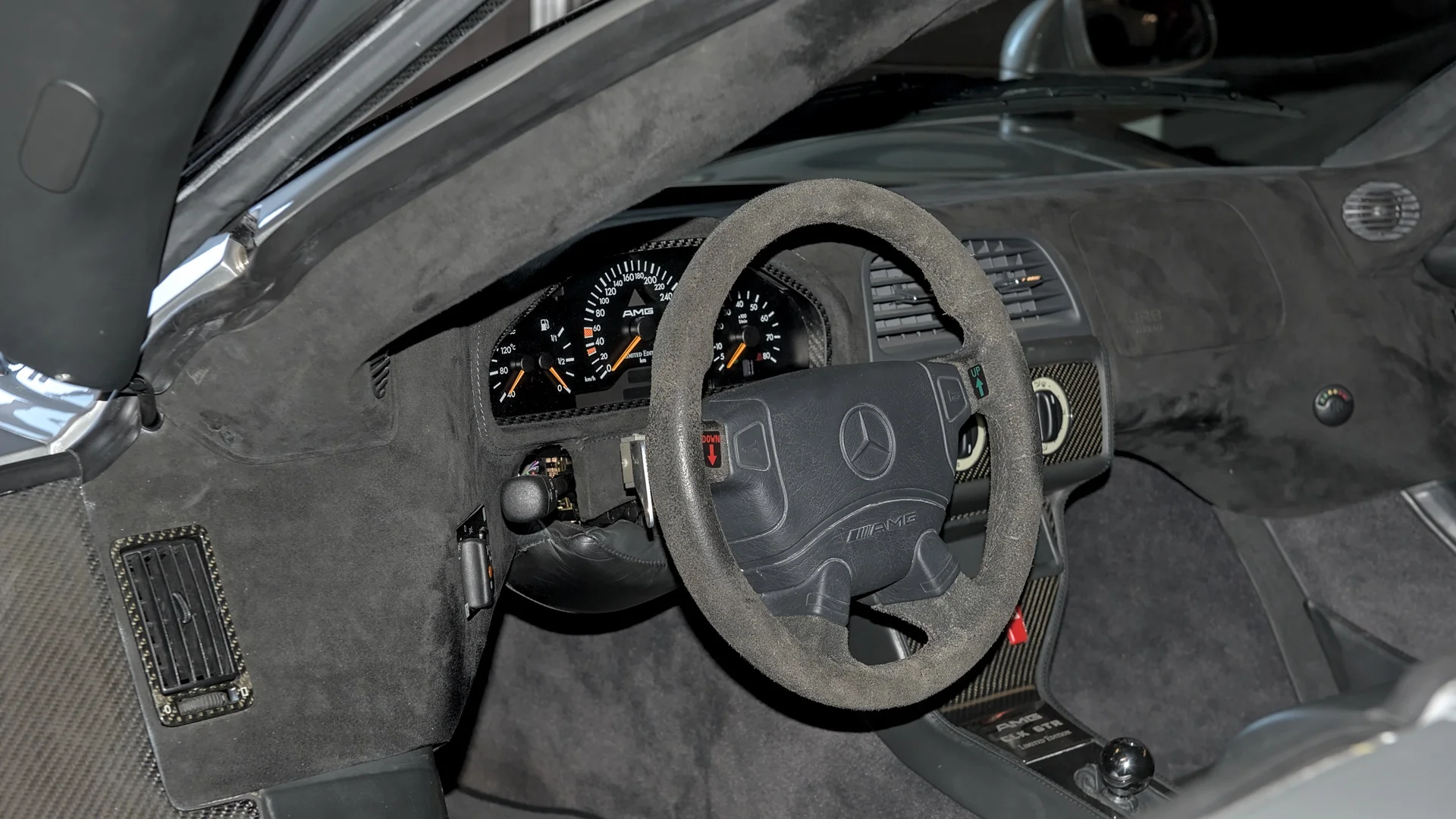
Inside, the “luxuries” were sparse. You got ABS, air conditioning, and a basic audio system. There were also minimal carpets, but don’t expect comfort in any way. Perhaps the most practical parts were the tiny, almost comical, luggage bins located under each dihedral door. These were just large enough for a toothbrush and a very thin wallet, goes to show this car was never meant for road use. The interior, though exquisitely finished, was still a claustrophobic, carbon-fiber-lined cockpit, designed for optimal driving position, not passenger comfort.
The CLK GTR Straßenversion was, in every sense, a barely tamed beast. It was designed to chew up race tracks, not cruise boulevards.
Part III: Performance, Rivalry, and the Driving Experience

So, what was it like to drive this multi-million-dollar legend? Imagine strapping yourself into a carbon-fiber cocoon, the world’s most powerful naturally aspirated V12 engine screaming directly behind your head. The CLK GTR was not for the faint of heart.
- Engine: 6.9-liter Naturally Aspirated V12
- Horsepower: 612 hp
- Torque: 572 lb-ft
- 0-60 mph: Approximately 3.6 seconds
- Top Speed: Around 199 mph (limited more by its immense downforce than raw power)
- Transmission: six-speed sequential manual gearbox with steering-mounted paddles.
These figures, while sensational, only tell half the story. To truly appreciate the CLK GTR, one must place it in context with its greatest rival: the McLaren F1. The F1, a road car that became a race champion, was known for its blistering top speed and everyday usability (comparatively speaking). The CLK GTR, a race car forced onto the road, was a different animal entirely.
On the track, the CLK GTR, with its aggressive aero, generated significantly more downforce than the F1, making it a faster, more planted machine through corners. However, the F1 was lighter at 2,508 lbs vs the CLK GTR’s 3,240 lbs (1,138 kg vs. 1,470 kg) and had a higher top speed. The CLK GTR’s uncompromising aerodynamic package, designed for extreme grip at speed, created so much drag that its theoretical top speed was reduced.
Driving the CLK GTR was an exercise in pure visceral engagement. The unsilenced V12, only inches from your ears, vibrated through the chassis, a constant reminder of the mechanical violence just behind you. The sequential manual gearbox, while thrilling, demanded precise timing and commitment. The heavy, aggressive carbon-fiber clutch was unforgiving in traffic. There was no power steering, no advanced electronic aids to smooth things over. Every input, every shift, every turn was raw, unfiltered, and utterly demanding. It wasn’t comfortable; it wasn’t quiet; it was a pure racing machine barely masked for the street. This uncompromising nature is precisely what makes it so revered.
Part IV: Rarity, Value, and Legacy

The Mercedes-Benz CLK GTR isn’t just a powerful car; it’s an incredibly rare one. Only 26 Straßenversion cars were ever built: 20 coupes and 6 highly sought-after roadsters. This extreme exclusivity is a primary driver of its stratospheric value.
When new in 1998, the CLK GTR commanded a price tag of approximately £1.1 million, or roughly $1.5 million at the time, earning it a Guinness World Record for the most expensive production car ever built (yes, before the Veyron). Fast forward to today, and that price looks like a bargain. Recent auction sales have seen CLK GTRs change hands for well over $10 million, with the even rarer roadster versions commanding a premium. This isn’t just appreciation; it’s a testament to its legend, its heritage, and its almost mythical status in the automotive world.
The CLK GTR’s racing success was spectacular, but its story has an interesting postscript. Its successor, the CLK-CLR, designed for the 1999 Le Mans 24 Hours, famously suffered from aerodynamic instability, leading to three terrifying “flips” during the event. This catastrophic failure led Mercedes to withdraw from top-tier endurance racing for many years, inadvertently solidifying the CLK GTR’s position as the glorious, successful pinnacle of their GT1 program. It was the last great roar before a temporary silence.
Today, the CLK GTR serves as a critical link in Mercedes-Benz’s hypercar lineage. It’s the spiritual successor to the legendary 300 SLR, and the uncompromising predecessor to modern marvels like the AMG ONE. It reminds us that Mercedes-Benz, when it truly commits, can build vehicles that redefine boundaries.

The Mercedes-Benz CLK GTR is more than just a car; it’s a monument to an audacious era of motorsport. A GT1 race car reluctantly adapted for the road, it remains an uncompromising, brutally fast, and incredibly rare machine. It wasn’t built for comfort or practicality; it was built to dominate, to win, and to cement Mercedes-Benz’s place at the top.
In a world increasingly filled with electronically assisted, refined supercars, the CLK GTR stands as a raw, visceral reminder of a time when race cars were barely distinguishable from their road-going counterparts. It’s a true homologation special, a street-legal icon, and a collector’s ultimate dream. The CLK GTR doesn’t just hold its value; it holds a permanent place in automotive history.