

When Honda set out to celebrate its 50th anniversary, they didn’t just throw a party; they engineered a masterpiece. The year was 1999, and the world was introduced to the Honda S2000, a high-revving, rear-wheel-drive roadster that would carve its name into automotive history. More than just a sports car, the Honda S2000 history is a tale of engineering brilliance, pure driving exhilaration, and an unwavering commitment to Honda’s sporting heritage.
From its incredible F20C engine that screamed to a 9,000 rpm redline to its near-perfect 50:50 weight distribution, the S2000 was a statement. It was a defiant, analog machine in an increasingly digital world, designed for enthusiasts by enthusiasts. Let’s take a deep dive into what makes this car so special and why it continues to captivate drivers today.
From Concept to Icon: The SSM Concept (1995)

The seed for the S2000 was planted long before its official launch. In 1995, at the Tokyo Motor Show, Honda unveiled the Sport Study Model (SSM) concept. This sleek, open-top two-seater gave the world a glimpse into Honda’s vision for a future sports car. While not identical to the production S2000, the SSM established key design principles: a front-mid engine layout for optimal balance, rear-wheel drive, and a focus on an exhilarating driving experience.
It was a nod to Honda’s past, specifically its original small-displacement roadsters like the S500, S600, and S800 from the 1960s. These cars were Honda’s first foray into four-wheeled vehicles, and the SSM (later the S2000) embodied that same spirit of lightweight, high-revving performance. The anticipation began to build, and enthusiasts started dreaming of what a modern Honda roadster could be.
Honda’s 50th Anniversary Gift: The Birth of the AP1 (1999)
Fast forward to 1999, and Honda was ready to celebrate its 50th anniversary in a spectacular fashion. What better way to mark half a century of innovation than with a sports car that pushed boundaries? The world was introduced to the production Honda S2000, bearing the internal chassis code AP1.
Under the guidance of chief engineer Shigeru Uehara (who also famously worked on the original NSX), the S2000 was engineered from the ground up to be a driver’s car. It wasn’t about raw power in a straight line; it was about balance, feedback, and an unparalleled connection between car and driver.
The Engine: The Legendary F20C
At the heart of the original AP1 S2000 lay one of the most celebrated engines in automotive history: the F20C. This 2.0-liter, naturally aspirated, DOHC VTEC four-cylinder engine was nothing short of a masterpiece. What made it legendary? Its 9,000 rpm redline. To put that into perspective, most production car engines barely touch 7,000 rpm. The F20C screamed its way to its power peak, delivering an intoxicating soundtrack and a thrilling surge of acceleration.
The F20C held the record for the highest specific output for any naturally aspirated production engine globally at the time, producing an incredible 120 hp per liter (124 hp/L in its Japanese domestic market tune, totaling 250 PS or approximately 247 hp). Even today, only expensive naturally aspirated supercars seem to be able to beat this car in terms of specific output. This monumental achievement showcased Honda’s engineering brilliance, honed over decades in Formula 1. Paired with a slick, short-throw six-speed manual transmission, often described as having a “rifle-bolt” precision, the drivetrain was an absolute joy.
The Chassis: An X-Bone Foundation
The S2000 wasn’t just about its engine. Its foundation was equally revolutionary. Honda developed a unique “High X-bone frame” chassis, where the main frame rails run over the top of the transmission and then split into an “X” shape under the passenger compartment. This design provided exceptional torsional rigidity, far surpassing many contemporary convertibles and even some coupes. The result? A car that felt incredibly solid and responsive, allowing the suspension to do its work without chassis flex interfering.
The AP1’s handling was precise, but notoriously “twitchy” at the limit, especially for less experienced drivers. Its firm suspension and quick steering demanded respect, making it a truly rewarding car for those who mastered it.
In 2002, the AP1 received minor updates, including a glass rear window (replacing the plastic one), revised suspension settings (springs and dampers), and updated oil jet bolts to address some early reliability concerns.
Here’s a quick look at the core specs of the AP1:
| Model | AP1 (1999-2003) |
| Engine | F20C 2.0L DOHC VTEC |
| Redline | 9,000 rpm |
| Horsepower (US) | 240 hp @ 8,300 rpm |
| Torque (US) | 153 lb-ft @ 7,500 rpm |
| Transmission | Six-speed manual |
| Drivetrain | Rear-Whelle Drive |
| Notable | Glass rear window (2002+), “twitchy” handling |
Evolution and Refinement: The AP2 Generation (2004–2009)
As time moved on, Honda listened to feedback and sought to broaden the S2000’s appeal while retaining its core spirit. For the 2004 model year, a significant update arrived, leading to the AP2 chassis code (though this was officially only for North America and Japan, other markets retained the AP1 designation but received the updates).
The Engine: F22C1 and a Lower Redline
The most significant change for the AP2 in the US and Japanese markets was the introduction of the F22C1 2.2-liter engine. This wasn’t just a bore increase; it was a strategic move. While the redline was lowered to 8,200 rpm, the increased displacement yielded more torque, particularly in the mid-range. This made the AP2 a more drivable and forgiving car for daily driving and less demanding on the track, where drivers didn’t always need to wring every last rpm out of the engine. The horsepower remained largely similar, but the power delivery became more accessible. European models, however, retained the 2.0L F20C engine throughout the S2000’s production run.
Refined Aesthetics and Handling
Beyond the engine, the AP2 brought a host of other refinements. Exterior updates included redesigned front and rear bumpers, new headlight assemblies, and stylish LED taillights. The 16-inch wheels were replaced with larger, more aggressive 17-inch alloys.
Crucially, Honda significantly re-tuned the suspension and increased the rear tire width. The goal was to make the S2000’s handling more stable and forgiving at the limit, addressing the AP1’s reputation for being snappy. The AP2 felt more planted and instilled greater confidence, without sacrificing its communicative nature. Later AP2 models also incorporated Drive-by-Wire throttle control and made Vehicle Stability Assist (VSA) an available (and eventually standard) safety feature, further enhancing control.
Here’s how the AP2 differs:
| Model | AP2 (2004-2009) |
| Engine | F22C1 2.2L DOHC VTEC (US/JDM) |
| Redline | 8,200 rpm (US/JDM) |
| Horsepower (US) | 237 hp @ 7,800 rpm |
| Torque (US) | 162 lb-ft @ 6,800 rpm |
| Transmission | Six-speed manual |
| Drivertain | Rear-Wheel Drive |
| Notable | Revised suspension, VSA (later models), more forgiving handling |
Special Editions and the Final Chapter
No legendary sports car history is complete without its special editions, and the S2000 delivered.
The S2000 Club Racer (CR)
S2000 Club Racer (CR)
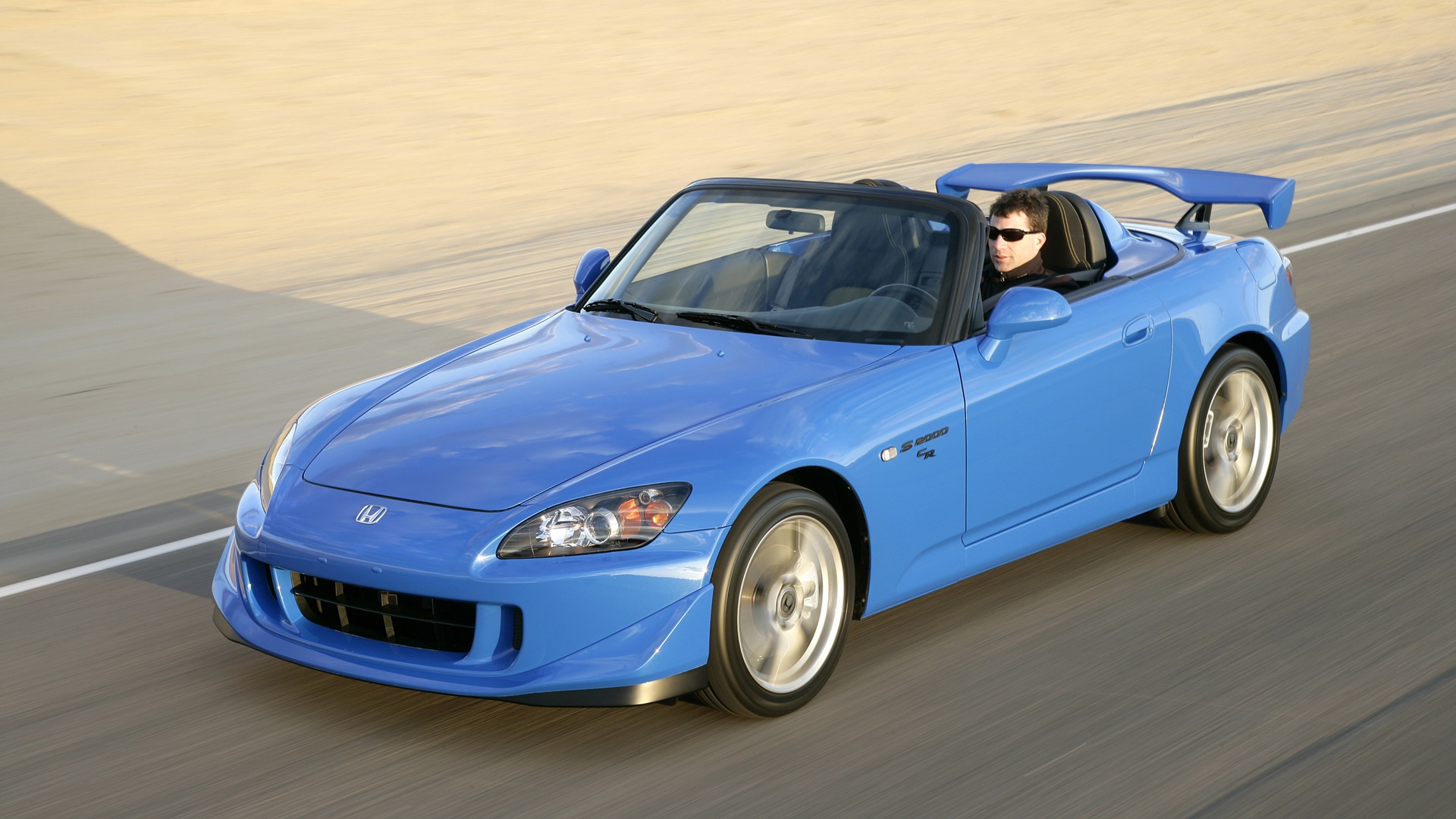
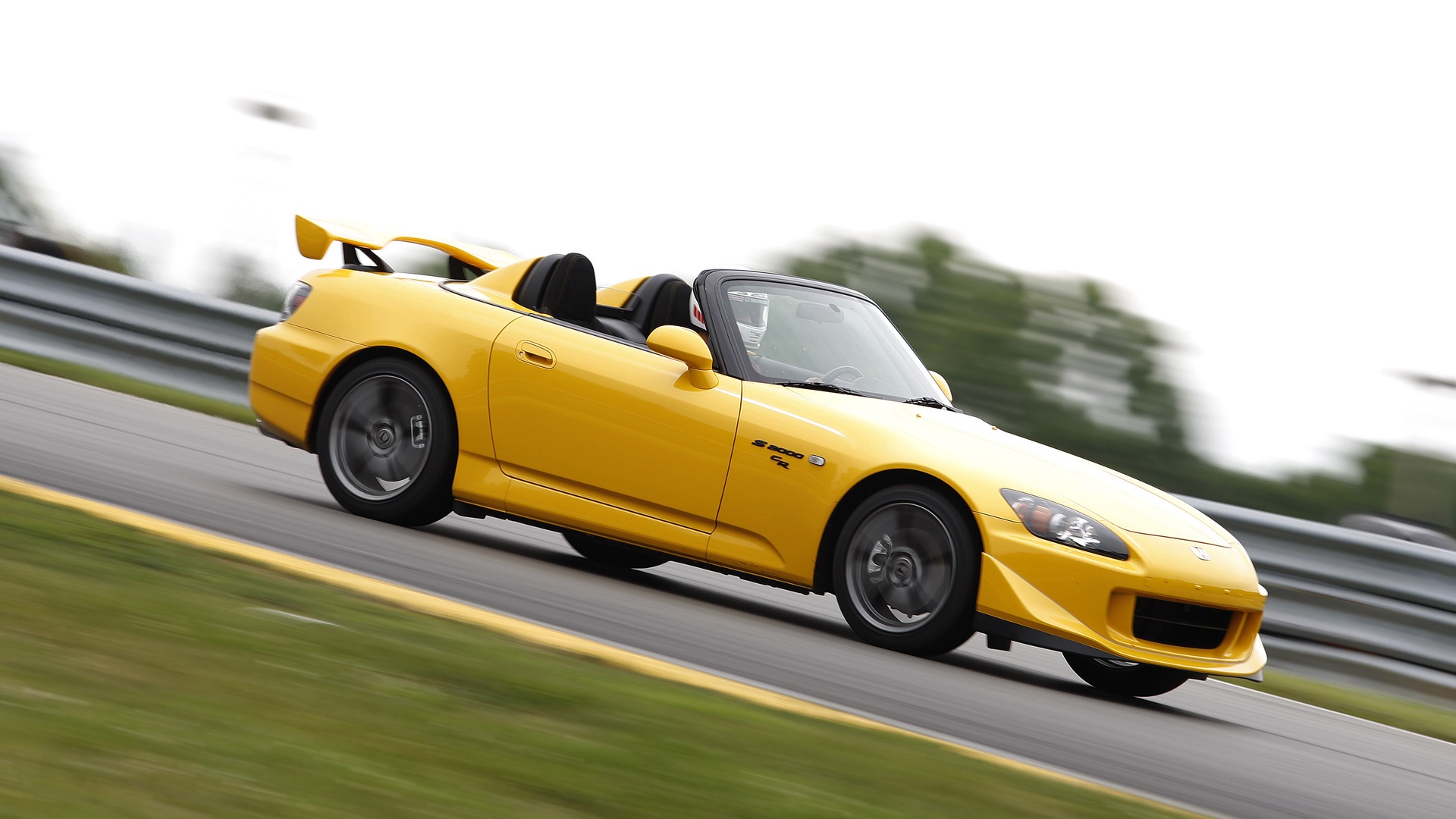
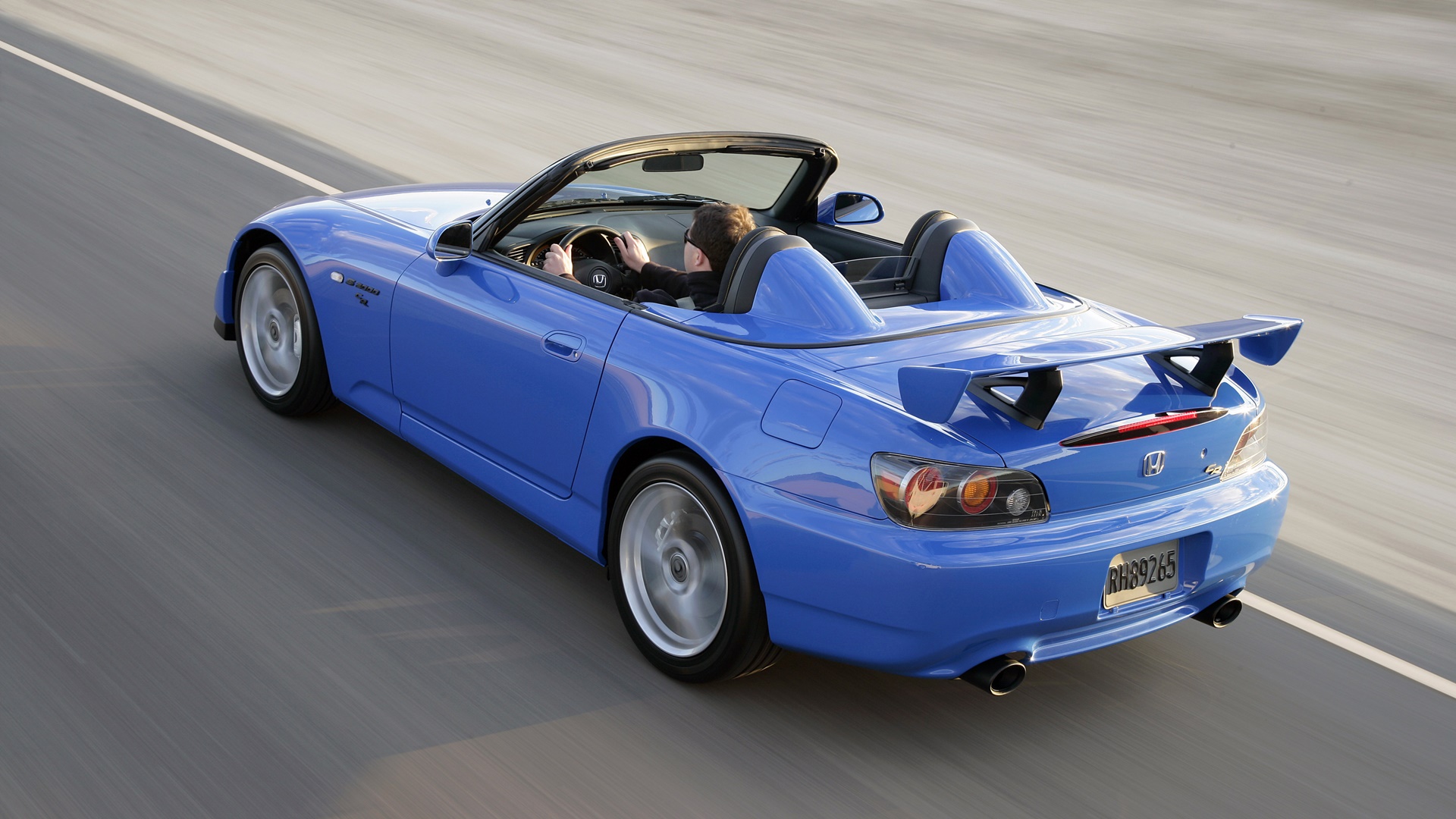
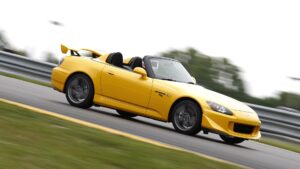
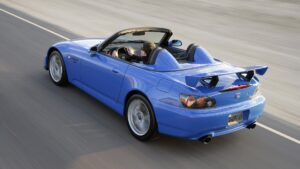
Perhaps the most coveted variant is the S2000 Club Racer (CR), introduced in 2008. Designed for the most hardcore track enthusiasts, the CR was lighter, stiffer, and more aerodynamically optimized. It featured a more aggressive suspension tune, a quicker steering ratio, a large front spoiler, and a massive rear wing. To save weight, it came without a soft top (replaced by a removable hardtop) and even got rid of air conditioning and a stereo as standard (though available as options). The CR is the ultimate expression of the S2000’s track-focused potential and commands a significant premium today.
Other notable editions included the Type V in Japan, which featured Honda’s innovative Variable Gear Ratio Steering (VGRS) system, and the Edition 100 in the UK, a final run of 100 individually numbered cars.
The production of the Honda S2000 ceased in June 2009. While popular, the changing automotive landscape with a greater focus on fuel economy and the onset of the global financial crisis led Honda to discontinue its dedicated roadster. It was a sad day for enthusiasts, but it also solidified the S2000’s status as a pure, uncompromised sports car from a bygone era.
The Honda S2000 Buying Guide
Today, the Honda S2000 is seen as a modern classic. Its unique driving experience, bulletproof Honda reliability (for the most part), and timeless styling have made it highly sought after. Unlike many cars that depreciate, the S2000 has seen significant appreciation, especially for low-mileage, well-maintained examples.
Buying Advice:
If you’re looking to own a piece of this legend, here’s what to consider:
- AP1 vs. AP2: The choice depends on your preference. The AP1 offers the higher-revving, more visceral engine, but demands more skill due to its snappier handling. The AP2 offers more mid-range torque and more forgiving handling, making it a better all-rounder for many. Neither is “better,” just different.
- Common Faults: While reliable, look out for potential issues like oil consumption (especially on early AP1s, regular checks are crucial), timing chain tensioner (TCT) noise, and “clutch buzz” (a common, usually harmless, characteristic). Check for rust, especially on subframes and suspension components in areas where salt is used on roads.
- Service History: A comprehensive service history is paramount. These are high-performance engines that require meticulous maintenance.
- Modifications: Many S2000s have been modified. While some mods are beneficial, highly modified cars can be a gamble. Look for well-documented, professionally installed upgrades.
A Pure Driving Machine
The Honda S2000’s legacy is secure. It represents a golden era of sports car development, where engineering purity took precedence. It’s a car that demands to be driven, rewards skill, and connects with its owner on a visceral level. Whether it’s the thrilling scream of the F20C at 9,000 rpm or the precise shift of its six-speed gearbox, the S2000 delivers an unfiltered driving experience that is increasingly rare in the modern automotive world.
Its story is one of innovation, passion, and a commitment to the joy of driving. And as time marches on, the legend of the Honda S2000 will only continue to shine brighter.


